On a weekday morning, the Ronda bullring is almost silent. You walk out onto the sand of the ruedo, the ring itself, and the two tiers of stone arcades close around you, more like a cloister than a stadium. In early September, the same stands hold several thousand people for the Corrida Goyesca, and in 2026 the tickets were gone five months ahead.
The bullring belongs to the Real Maestranza de Caballería de Ronda, a riding order founded by the local nobility in 1573. It still runs the visit, the museum and a riding school next door.
Visiting the Ronda bullring
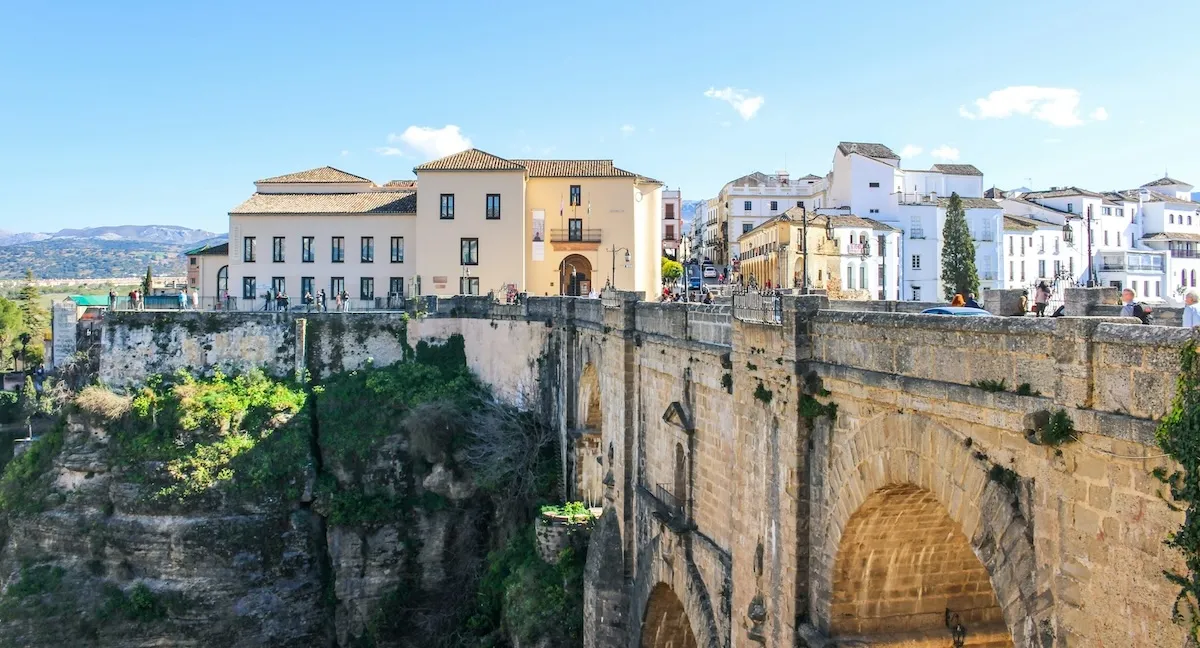
The Plaza de Toros de Ronda is on Calle Virgen de la Paz, a few minutes' walk from the Puente Nuevo. It is open every day, except on bullfight days, and the ticket covers the ring, the stands, the museum rooms and the dressage ring of the riding school. The shop sits at the end of the route.
Once inside, you can walk out on the sand, then climb up to the covered seats for the view across the ring. The museum rooms are tucked under the stands.
Take the audio guide: it costs €2 more, comes in 13 languages, and turns a pleasant walk into an actual visit. And whatever you think of bullfighting, the building and the harness collection alone are worth the €10.
- Price: €10; €12 with audio guide; €8 per person for groups of 15 to 30, guide included.
- Hours: daily; 10:00 to 18:00 from November to February, 10:00 to 19:00 in March and October, 10:00 to 20:00 from April to September. Closed on bullfight days.
- Address: Calle Virgen de la Paz 15, Ronda. Tel. +34 952 871 539.
Inside: the museum rooms
The Tauromachy Room, under the shaded stands, opened in 1984 and was renewed in 2023. It traces the bull from ancient myths to the modern bullfight, with paintings from the 17th to the 19th centuries, prints by Goya, costumes, and the two Ronda dynasties of bullfighters, the Romeros and the Ordóñez family. It also covers the controversy around bullfighting and the place of women in it. Since 1999, an artist has designed the poster of the Corrida Goyesca every year; the originals by Miquel Barceló, Eduardo Arroyo and others hang here.
The Royal Saddlery is the surprise of the visit. King Louis-Philippe of France gave these harnesses, saddles and liveries to his son, the Duke of Montpensier, who lived in Andalusia from 1846. There are two full sets, one for gala days and one for everyday use, on show since 2006.
The Real Maestranza Room, opened in 2019, tells the story of the order, with a model of Ronda as it looked in 1785. Next door, the Equestrian Gallery and the indoor dressage ring cover the Spanish purebred horse and classical dressage. ¡Ojo!: at times, you can watch the school's riders training.
A short history of the Plaza de Toros de Ronda
The Real Maestranza first asked for permission to build a bullring in 1754. Until then, its riding exercises and bull games took place in town squares, including the one in front of Santa María la Mayor. The town gave the land in 1769, and building started in earnest in 1779.
It did not go smoothly. In 1784, during a bullfight held before the works were finished, part of the arcades collapsed, killing ten people and injuring twelve. The ring was completed the following spring and officially opened on 19 May 1785, with the matadors Pedro Romero and Pepe Hillo.
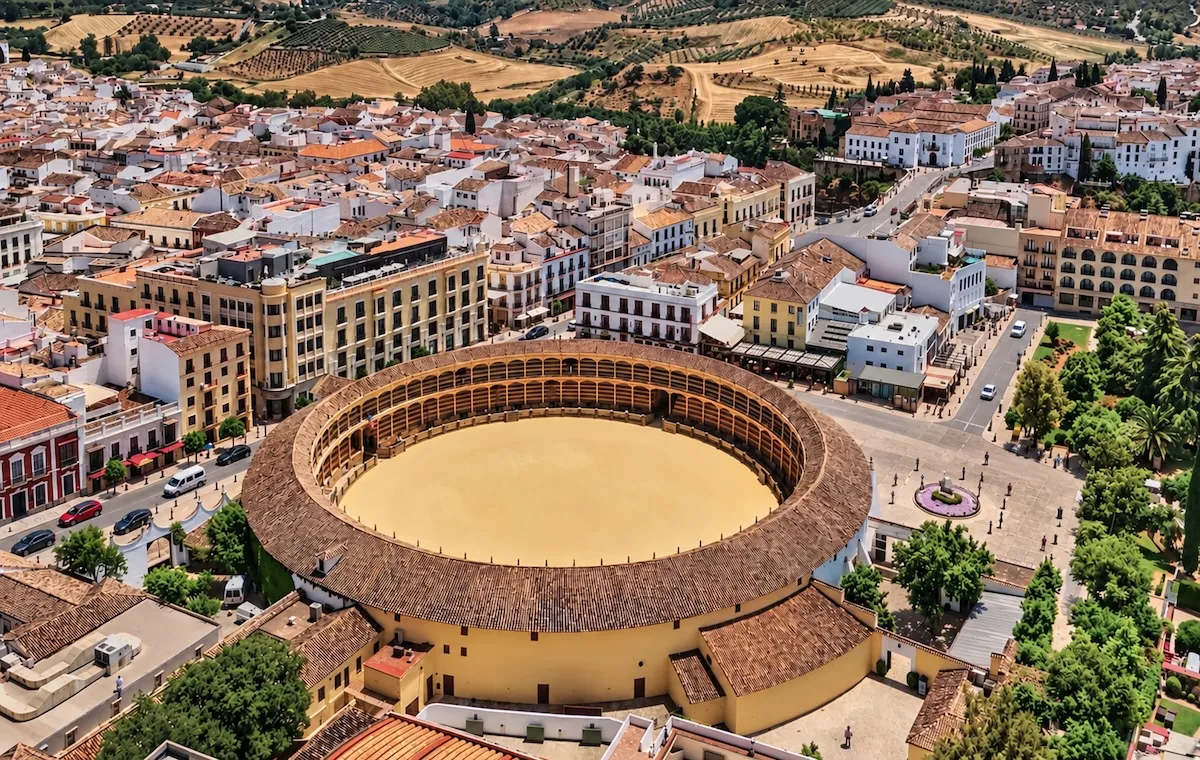
The round shape was a choice in itself. It left behind the square plazas of the riding nobility and gave the stage to bullfighting on foot, which was taking over at the end of the 18th century. The Real Maestranza describes its ring as the first building ever designed for bullfights.
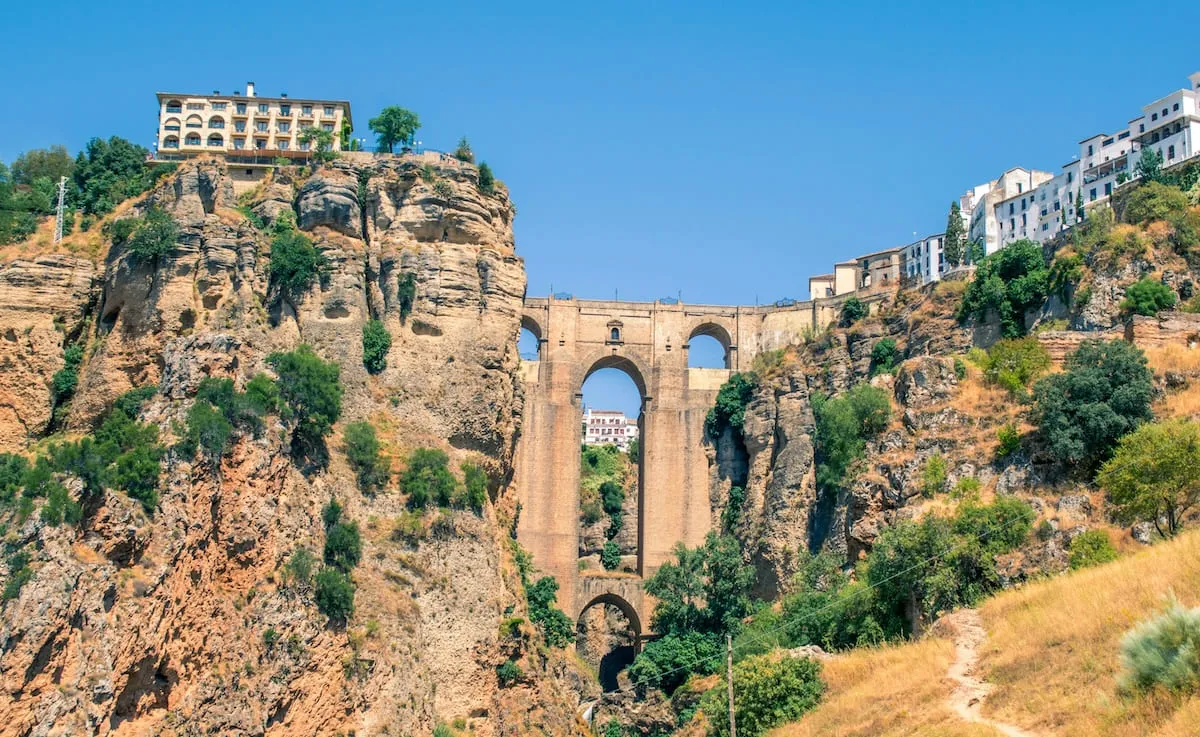
The design is attributed to José Martín de Aldehuela, the architect who finished the Puente Nuevo, although his name appears in no document. The main gate was moved to its current place on Calle Virgen de la Paz in 1923, and the bullring has been listed as a Bien de Interés Cultural since 1993.
The architecture
The ring is 66 metres across, surrounded by a passage formed by two rings of stone. The stands rise on two levels of five rows each, under 136 Tuscan columns that form 68 arches, all of them roofed: there is no open-air seating. The yellowish sandstone gives the whole building its colour. Look for the royal box, the palco real, the only arch with fluted columns and floral decoration.
It was planned for 4,819 spectators. Between 2024 and 2026, the arcades were reinforced in a consolidation project led by the architect Ricardo Aroca, costing more than two million euros. Bullfights stopped during the works, but visits went on, and the ring reopened for the September 2026 fair.
Pedro Romero, the Ordóñez family and the Corrida Goyesca
Pedro Romero, born in Ronda on 19 November 1754, is counted by the Real Maestranza among the founding figures of modern bullfighting. Two centuries later, in September 1954, the matador Cayetano Ordóñez, known as Niño de la Palma, pushed for a bullfight to mark the bicentenary of his birth, with the matadors and the ring dressed as in the time of Goya, who painted Pedro Romero and his brother José.
It was meant as a one-off. It came back in 1957 with his son Antonio Ordóñez, born in Ronda in 1932, who turned it into a fixture of the season until his death in 1998. His grandson, Francisco Rivera Ordóñez, organises it today, during the Feria de Pedro Romero in early September.
Do not count on getting in on the day. For the 67th Goyesca, on 5 September 2026, tickets sold out in April, the day they went on sale, and resale prices passed €1,500. If you are in Ronda that weekend without a ticket, the bullring is closed to visitors on bullfight days, so plan the visit for another day.
Hemingway and Orson Welles
Two Americans are tied to the Ronda bullring through Antonio Ordóñez. Ernest Hemingway wrote about his 1959 rivalry with Luis Miguel Dominguín in The Dangerous Summer. Orson Welles spent many summers in Ronda; his ashes rest at El Recreo de San Cayetano, the Ordóñez family estate.
Both have a monument, unveiled in 2015, on Paseo de Blas Infante behind the bullring, and a promenade named after them nearby.
For the rest of the day, see what to see in Ronda; and to sleep two minutes from the ring, our selection of hotels in Ronda includes the Hotel Don Miguel, 200 metres away. To eat opposite the ring, the Restaurante Pedro Romero is in our selection of restaurants in Ronda.
Frequently asked questions
How long does a visit to the Ronda bullring take?
About an hour for the ring, the stands and the museum rooms. Allow up to 90 minutes if you take the audio guide and read everything in the museum.
Is the Ronda bullring accessible by wheelchair?
Partly. The entrance level, the arena floor and the main museum level are accessible, but the upper stands and some areas under the stands are reached by steep stone steps.
Can you see a bullfight in Ronda, and how do you get tickets?
Only during the Feria de Pedro Romero in early September, when the ring hosts a handful of events, including the Corrida Goyesca. Tickets are sold by the bullring's promoter months in advance: for the 2026 Goyesca, they sold out in April, the day they went on sale. The rest of the year, the ring is open as a museum.
Is the visit suitable for children?
Yes. There is no show during the visit: you walk through the empty ring, the stands and the museum, and you can sometimes watch horses training at the riding school. Ask at the ticket office about rates for children.
Do you need to book the visit in advance?
No. Tickets are sold at the entrance on Calle Virgen de la Paz, with no timed slots, and the visit rarely sells out. The only days you cannot get in are bullfight days, when the ring is closed to visitors.