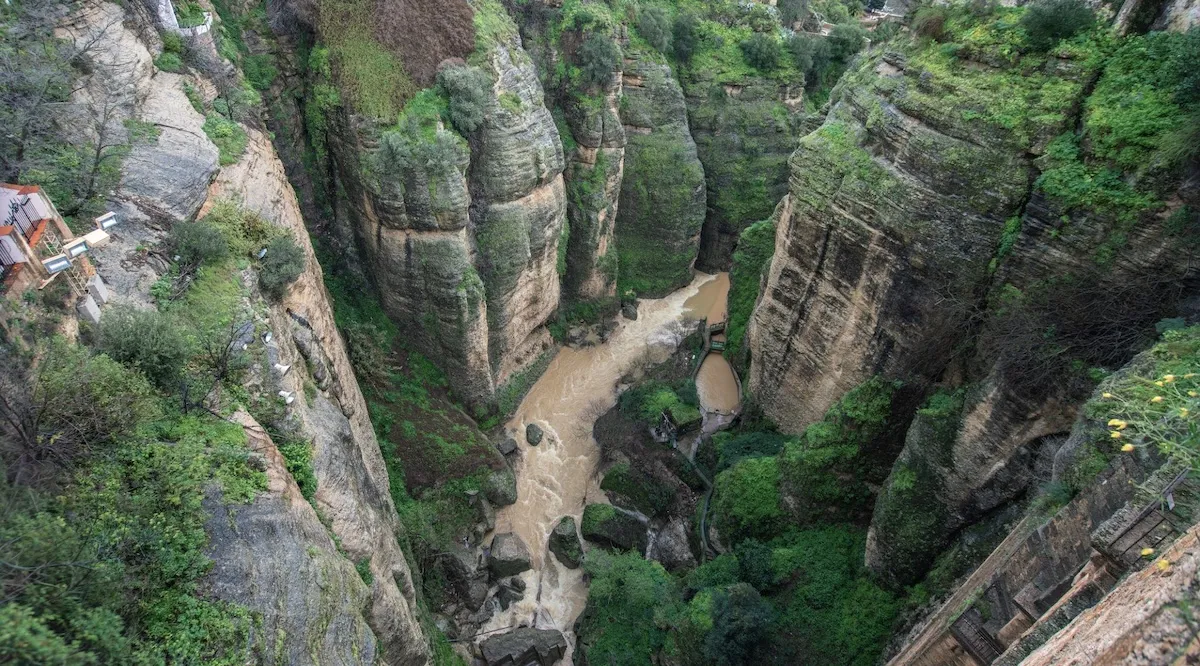
Walk onto the Puente Nuevo from Plaza de España and the first thing you notice is the drop: the río Guadalevín runs about 98 metres below, at the bottom of the gorge locals call El Tajo. The second thing, a few steps later, is that you cannot see the bridge. The arches are under you. To get the picture you came for, you have to step off it, go round the edge of the gorge, or walk down into it.
Most of the best views are free, and all are within a short walk of the bridge.
A bridge built twice
The Puente Nuevo is the second attempt. A first bridge, a single arch about 35 metres wide, was started in 1735 and collapsed in 1741, killing around 50 people. The town decided to build again in 1751, work resumed properly in 1759, and the new bridge opened to traffic in 1787 before being finished in 1793. Several architects worked on it; the one Ronda remembers is José Martín de Aldehuela, who built the great central arch and the roadway. The stone came from the gorge itself, which is why the bridge seems to grow out of the cliffs.
Above the central arch is a chamber that was once a prison. It now holds a small interpretation centre about the bridge's construction, entered from Plaza de España. A local legend has Aldehuela falling to his death from his own bridge; nothing documents it, so take it as a story.
The interpretation centre is small. It is worth it as part of the municipal bono (€12), which also covers the Casa del Gigante and the Baños Árabes, less so on its own.
- Bridge: free, open at all hours.
- Interpretation centre: €2.50, reduced €2, free for under-8s. Winter hours: Tuesday to Friday 9:30 to 19:00; Monday and Saturday 10:00 to 14:00 and 15:00 to 18:00; Sundays and holidays 10:00 to 15:00. In summer, it stays open until 20:00 from Tuesday to Friday.
From the top: Aldehuela, Cuenca and the Parador
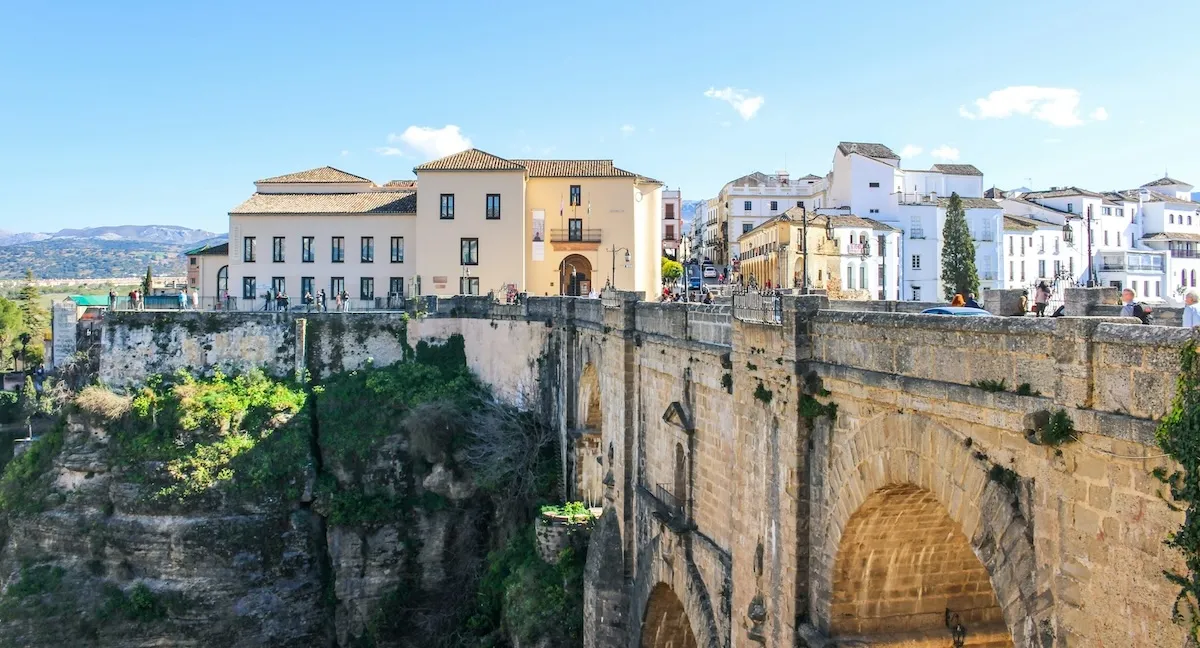
The Mirador de Aldehuela is the closest viewpoint, one to three minutes from Plaza de España, on a rocky terrace at the end of the bridge beside the Convento de Santo Domingo. It is almost flat, so it works with a pushchair or limited mobility. You look along the side of the bridge and down into the gorge, and the morning light is the best here.
Opposite, the Jardines de Cuenca are terraced gardens cut into the edge of the gorge, five to ten minutes away. Each level gives a slightly different angle on the bridge, and there are far fewer people than at Aldehuela. Morning or late afternoon both work.
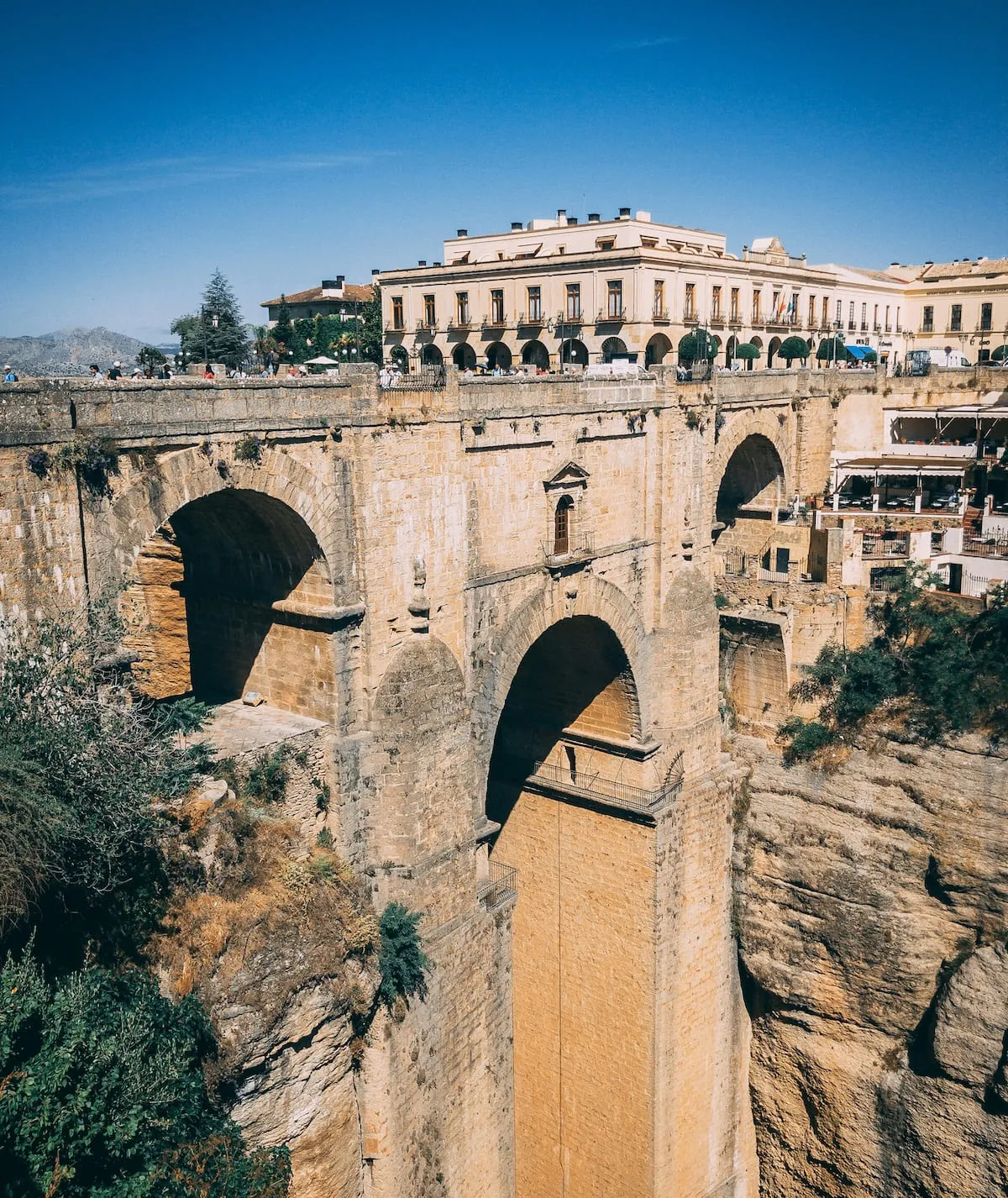
The building behind the bridge in this photo is the Parador de Ronda, the former town hall. Its cafeteria, open from 11:00 to midnight, has a terrace over the Tajo. We could not confirm whether non-guests are always welcome there, so ask at the cafeteria. If you would rather wake up to this view, the Parador is one of our hotels in Ronda.
- Price: free (a drink at the Parador if they let you in).
- Best light: morning at Aldehuela; morning or late afternoon at the Jardines de Cuenca.
Down the Camino de los Molinos
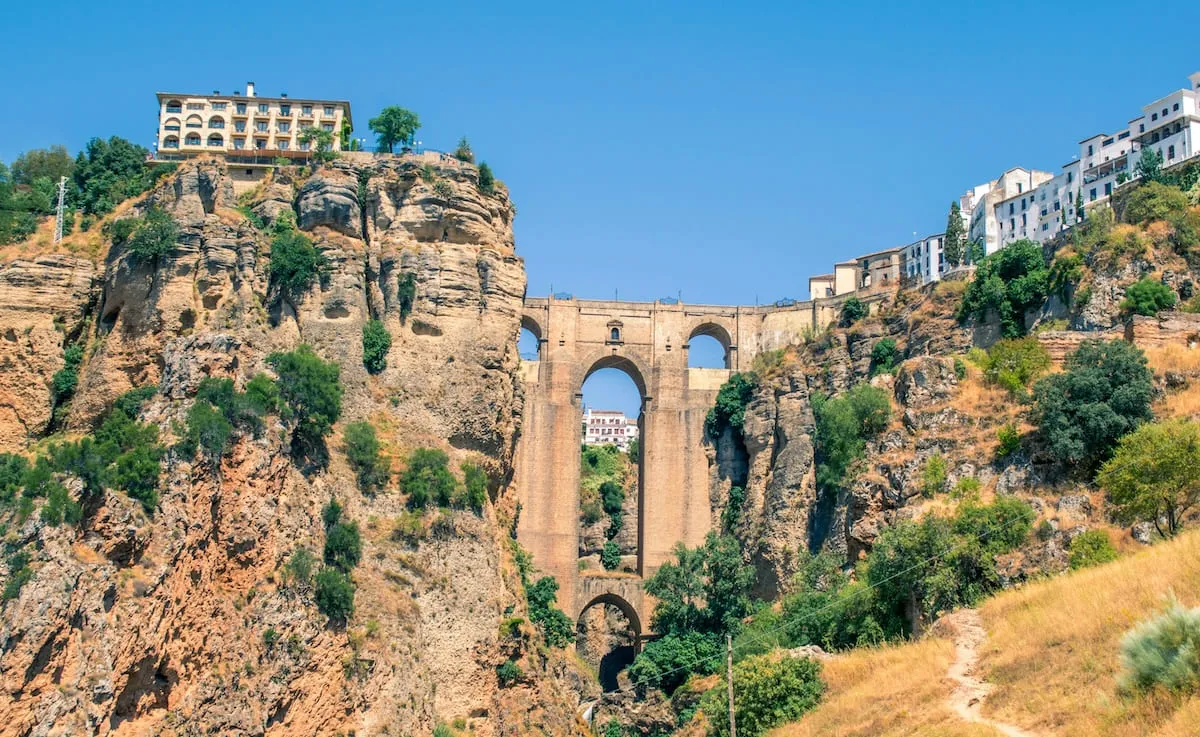
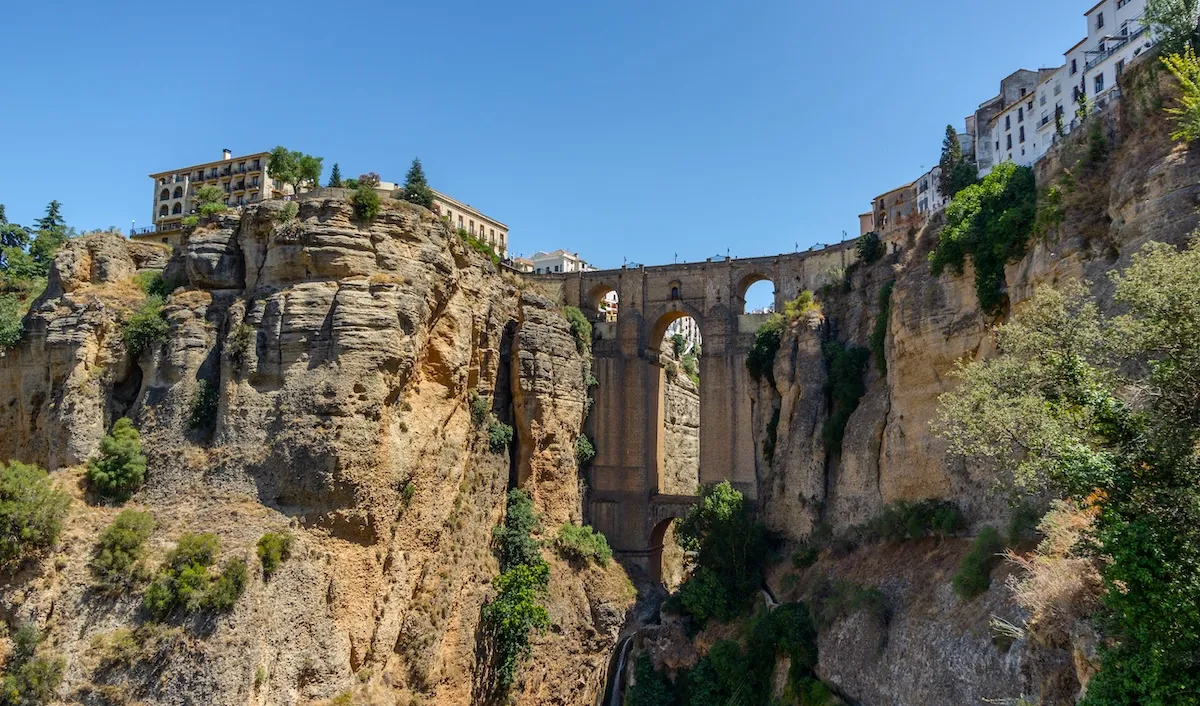
This is where the classic picture is taken, the one with the bridge standing whole between the cliffs. The Camino de los Molinos starts at Plaza de María Auxiliadora, five to ten minutes' walk from the bridge through La Ciudad, the old town, and zigzags down the slope below the cliffs.
About 180 metres down, you pass the entrance to the paid gorge walkway described below. Keep to the public path. After fifteen to twenty minutes of descent, you reach the Arco del Cristo, an old stone gateway that frames the bridge from below. It is free, and in our opinion it is the best view in Ronda for the effort. Come 60 to 90 minutes before sunset, when the light warms the stone, rather than at sunset itself.
Further down, the Mirador de la Hoya del Tajo shows the bridge, the cliffs and the town together. It is also free. From there, the bridge looks smaller than you expect: use a 2x zoom rather than your widest lens.
¡Ojo!: the way back up is steep and takes about twice as long as the way down. Bring water in summer, wear proper shoes, and start the climb before dark.
- Price: free.
- Best light: late afternoon, 60 to 90 minutes before sunset.
Inside the gorge: the Desfiladero del Tajo
Since 15 September 2026, a path and a series of walkways run through the bottom of the gorge, from Plaza de María Auxiliadora to the Padre Jesús district, next to the Baños Árabes. The route is almost a kilometre long: the first section, open since April 2024, leads to the foot of the Puente Nuevo, and a 500-metre walkway now continues beside the river.
From down there, you see the bridge from directly underneath, with the rock walls rising on both sides. No free viewpoint gives you that, and it is worth the ticket. But it is not a place for a photo session: drones and tripods are not allowed, nor are bulky rucksacks, animals or children under 8. Bring a phone or a camera you can hold.
- Price: €12, free for Ronda residents. Book a time slot on turismoderonda.es.
- Hours: winter 9:00 to 17:00; spring and autumn 10:00 to 20:00; summer 10:00 to 14:00 and 18:00 to 21:00.
The Puente Viejo
The Puente Viejo, the old bridge ten to fifteen minutes east of the Puente Nuevo near the Baños Árabes, gives a view upstream towards it. The bridge is further away and smaller in the frame, so this is a picture of the gorge more than of the bridge. It fits naturally at the end of the Desfiladero route, which finishes in the same area.
A half-day photo route
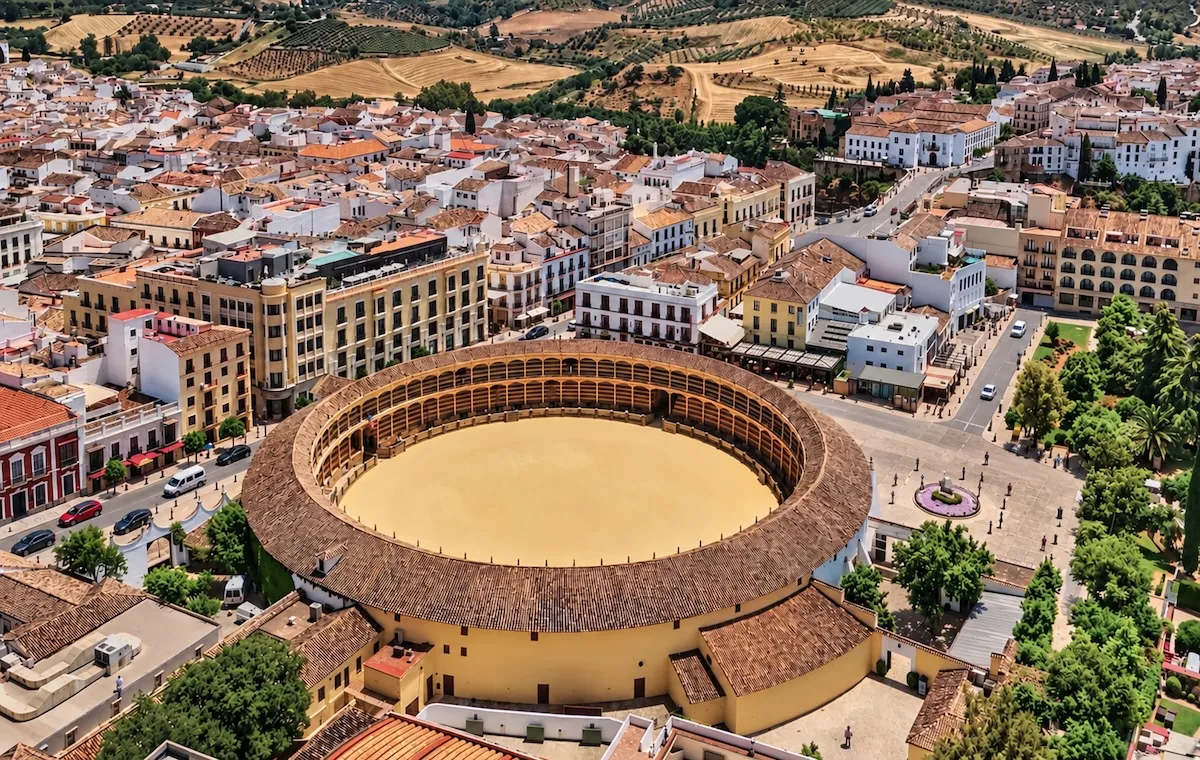
Start in the morning on top: the bridge itself, the Mirador de Aldehuela, then the Jardines de Cuenca. Break for lunch at one of our restaurants in Ronda, and if you have the time, visit the rest of La Ciudad or the bullring. In the late afternoon, walk to Plaza de María Auxiliadora, go down the Camino de los Molinos to the Arco del Cristo and the Hoya del Tajo, and come back up before dark. If you book the Desfiladero, take an afternoon slot and finish at the Puente Viejo.
One practical warning if you come by car: since August 2025, only vehicles registered in Ronda can drive across the Puente Nuevo, and cameras check. Leave the car in a car park first; our guide to parking in Ronda lists the closest ones. For everything else to see in town, see what to do in Ronda.
Frequently asked questions
Is the Puente Nuevo free to visit?
Yes. Crossing the bridge is free at any hour, and so are the Mirador de Aldehuela, the Jardines de Cuenca, the Arco del Cristo and the Mirador de la Hoya del Tajo. Only the interpretation centre inside the bridge (€2.50) and the Desfiladero del Tajo walkway (€12) are paid.
Can you go under the Puente Nuevo?
Yes, with the Desfiladero del Tajo walkway, which runs along the bottom of the gorge right under the bridge. It costs €12, free for Ronda residents, and you need to book a time slot. The platform at the foot of the bridge, the Mirador del Puente Nuevo, is part of this paid route.
What is the best time to photograph the Puente Nuevo?
Morning for the viewpoints at the top, the Mirador de Aldehuela and the Jardines de Cuenca. Late afternoon for the views from below: at the Arco del Cristo, arrive 60 to 90 minutes before sunset rather than at sunset itself.
Can you fly a drone over the Tajo gorge?
Not on the Desfiladero del Tajo walkway, where drones and tripods are banned. Elsewhere, the gorge runs through the town, and drone flights in Spain follow the rules of AESA, the national aviation authority: check the ENAIRE drone map and any authorisation you need before flying.
How long does it take to walk down to the Arco del Cristo and back?
Count 15 to 20 minutes down from Plaza de María Auxiliadora and about twice as long to climb back, so 40 minutes to an hour of walking, plus time for photos. Going on to the Mirador de la Hoya del Tajo adds 10 to 15 minutes each way.